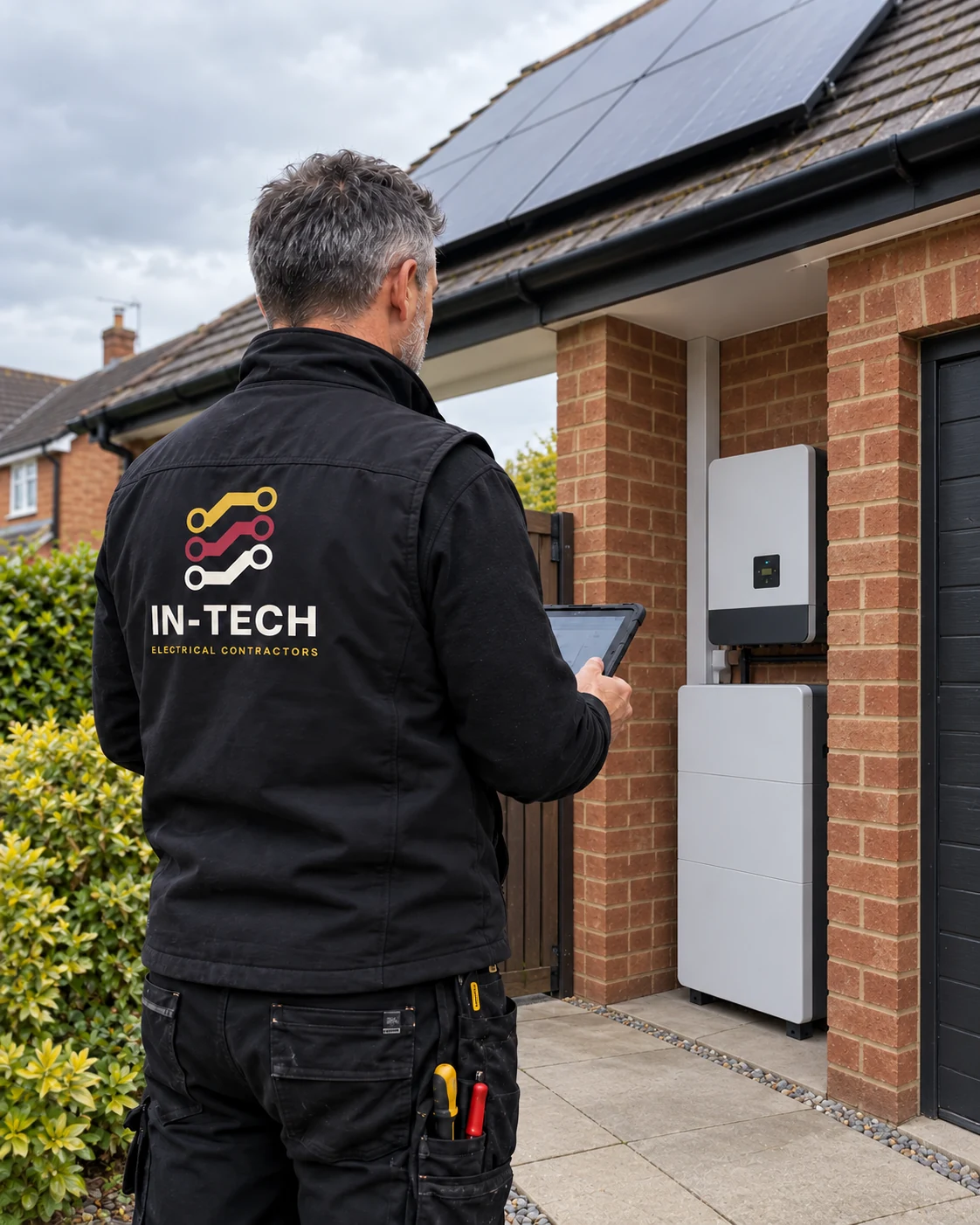
IN-TECH installs solar panels and battery storage for homes and businesses across Wirral, Liverpool and Chester. We assess your electricity use, roof, existing equipment and future plans to recommend a practical system. Expect conscientious installation, discreet equipment positioning and a clear explanation of how to generate, use and store your energy.
Tell us whether it’s for your home or business and what you have in mind.
Make More of Your Energy
GenerateSolar PV
UseYour Property
StoreSurplus for Later
Thorough Site Assessment
Thoughtful Equipment Positioning
Testing & Clear Handover
Start with your property
Which Solar and Battery System Is Right for Your Property?
01
Do You Need Solar Panels and Battery Storage Together?
Generate electricity from daylight and store surplus for later. Planning the panels, inverter and battery together lets us consider how the whole system will work, with the roof, electrical supply and your energy use assessed from the outset.
02
Can We Add Storage to Your Existing Solar?
Retrofit battery storage can help you use more of the electricity your panels already generate. We check your inverter, existing installation and monitoring before recommending compatible equipment or any changes needed.
03
Could Battery Storage Work without Solar Panels?
A suitable battery can charge from the grid during cheaper tariff periods and supply electricity later. We assess your usage, tariff, usable storage and power requirements to establish whether a standalone system makes sense.
How Could Solar and Storage Work for Your Home or Business?
For your home
How Can Homes Use More of Their Solar Electricity?
Home battery storage can move surplus generation into the evening, when you may need it more. We consider household routines, seasonal demand and future plans for electric heating or EV charging.
The aim is to make better use of your generation and reduce grid imports where practical. Year-round grid independence needs a different assessment; a battery alone does not guarantee it.
For your business
How Should Businesses Assess Commercial Solar and Battery Storage?
Commercial solar PV installation starts with your operating hours and electricity demand. Recent bills and interval consumption data, where available, help us assess daytime use, storage opportunities and future loads.
We also review the supply, including three-phase arrangements where applicable, roof permissions, access and disruption. Shifting energy purchases to cheaper periods differs from reducing peak power demand; the value of each depends on your site and charging structure.
What Solar Output and Battery Capacity Do You Need?
We look at when you use electricity, not just the annual total. The battery’s power rating matters too: storing enough energy does not mean it can supply every appliance at once.
What Do the System Ratings Tell You?
Measure
What it means for your installation
Panel capacity · kWp
The PV array’s rated peak output under standard test conditions. Actual output changes with conditions.
Generation · kWh
The electricity generated over a period. Annual estimates depend on location, roof orientation, shading and seasonality.
Usable battery capacity · kWh
The energy available within the battery’s permitted operating range, rather than its headline total capacity.
Battery power · kW
How quickly the system can charge or discharge. This affects the loads it can support at the same time.
We assess these figures alongside your usage profile, available solar surplus and future demand. Battery size should not be chosen solely by bedroom count or the number of panels.
Should You Use a Hybrid Inverter or an AC-Coupled Battery?
A hybrid inverter can combine solar and battery functions in one unit. An AC-coupled battery has its own inverter and may allow an existing solar inverter to stay in place.
When Could a Hybrid Inverter Suit a New Installation?
For new solar and storage, a compatible hybrid system can bring generation and battery management together. We review panel configuration, battery compatibility, power requirements and space before selecting the arrangement.
When Could AC-Coupled Storage Suit Existing Solar?
Adding a separate battery inverter may retain a functioning PV inverter. We compare this with replacing the existing inverter, considering its condition, controls, monitoring and any export restrictions.
Neither arrangement automatically includes power-cut backup. That needs suitable equipment and a specific design.
What Affects Solar and Battery Costs and Return on Investment?
The right system depends on what you can generate, when you use electricity and what you pay for it. We assess installation cost alongside expected energy use, tariff options and export arrangements, with the assumptions clearly explained.
What Shapes Your Installation Cost?
Factor
What we assess
Panels & roof access
Array size, roof suitability, mounting, shading and safe access.
Storage & inverter
Usable battery capacity, charge/discharge power, compatibility and controls.
The relevant application or notification and any export limitation requirements.
Backup, if specified
Essential loads, equipment, isolation arrangements and the required runtime.
How Could Off-Peak Charging Reduce Peak-Tariff Purchases?
Time-of-use tariffs can allow a battery to charge when electricity is cheaper and discharge later. The benefit depends on the rate difference, your demand, charging limits and round-trip efficiency. Tariffs can change, so the model should show which rates have been used.
How Should You Compare Solar-Only and Solar-Plus-Battery Payback?
Start with a solar-only proposal, then compare the additional cost and benefit of storage. Include avoided imports, charging costs, forgone export income, battery losses, degradation and possible equipment replacement. A single payback figure without these assumptions tells you very little.
Smart Export Guarantee eligibility and supplier terms need checking for the proposed installation. Ask us to explain the equipment warranty and any installation cover, including exclusions and the claim route, as part of your proposal.
How Do We Install and Commission Commercial Solar PV and BESS?
Battery energy storage systems (BESS) need to suit the site’s demand, supply and operating arrangements. We assess commercial installations alongside domestic solar and storage, with the relevant specialist design input and site requirements agreed for the proposed scale.
How Are Solar Arrays and Strings Planned?
Panel layouts, stringing and inverter inputs are assessed against the array design, shading, equipment limits and cable routes. We coordinate the electrical installation with roof access, mounting and any structural or specialist requirements.
What AC and DC Protection Is Needed?
We assess isolation, earthing, protective devices and surge protection on the AC and DC sides as applicable to the design. Cable selection, containment and labels are planned around the equipment and installation environment.
How Are Inverters and Battery Systems Commissioned?
We check the equipment configuration, communications, monitoring and agreed operating settings. Battery siting, protection and emergency arrangements need their own assessment; backup operation is included only where specifically designed.
What PV Inspection and String Testing Is Included?
Grid-connected PV inspection, commissioning tests and documentation follow the applicable BS EN 62446-1 (IEC 62446-1) scope. Checks include the relevant polarity, insulation and string-current verification, with DC short-circuit current testing where appropriate to the specified test method and equipment. Battery and hybrid functions require their own applicable checks and manufacturer procedures.
G98/G99 DNO applications or notifications are assessed against the complete generation and storage arrangement, including inverter ratings and any export limitation. Limiting export does not by itself remove the need to follow the relevant connection process.
A good installation should work well and sit comfortably within your property. We consider less prominent locations, tidy cable routes and future servicing from the outset, while respecting the equipment’s installation requirements.
Clearances, ventilation, the installation environment, access and manufacturer requirements shape the final position. We explain the options for your property before settling on a layout.
What Network Checks, Testing and Handover Are Included?
We assess the Distribution Network Operator connection route for the complete system, including the relevant G98 or G99 process and any G100 export limitation where required. The arrangement determines whether notification or prior approval is needed.
The agreed installation includes the relevant commissioning, electrical inspection and testing, and an explanation of controls. Electrical records are provided as appropriate to the completed work. Monitoring setup and network paperwork can be coordinated where included in the agreed scope.
Assess
Review the roof, supply, existing equipment and electricity use. Investigate the details that could affect performance or installation.
Design & Explain
Compare the suitable system options, proposed equipment position, costs and connection requirements. Explain the assumptions behind any estimates.
Install, Test & Handover
Complete the installation, test and commission it, then explain operation and the documents you receive.
What Should You Know before Booking?
How Long Does Battery Storage Take to Pay for Itself?
There is no single payback period. It depends on installation cost, electricity use, tariff differences, solar surplus, export payments and battery losses. We assess solar and storage together, then compare the additional cost and benefit of adding a battery. Any estimate should state its assumptions and allow for equipment ageing.
Can You Add a Battery to My Existing Solar Panels?
Often, yes. Depending on your equipment, an AC-coupled battery system may retain your existing solar inverter, while another approach may use a compatible hybrid inverter. Send your inverter make and model, existing system details and available paperwork so we can assess the suitable options.
Do Solar Panels and Batteries Need Grid Connection Approval?
Your installation needs the appropriate Distribution Network Operator connection process. Some eligible systems can be connected and notified; others need approval before connection. The route depends on the combined system, inverter ratings and export arrangements. We assess the proposed design and explain the applicable requirements before installation.
Will Solar and Battery Storage Keep My Property Running During a Power Cut?
Only if backup capability is included in the system design. A standard grid-connected installation does not automatically supply your property during an outage. Suitable equipment, isolation arrangements and circuit selection are needed. Tell us which essential loads you want supported so we can assess their power and runtime requirements.
Can a Battery Charge Overnight and Reduce Peak-Time Electricity Costs?
A suitable battery can charge during cheaper tariff periods and supply electricity later. The benefit depends on your tariff, usable capacity, charging and discharging limits, losses and electricity demand. We assess these factors together rather than assume that the cheapest overnight rate guarantees the best overall saving.
Ready to Discuss Solar or Battery Storage?
Planning solar, adding a battery or comparing the options? Send your postcode and tell us whether the work is for a home or business. If you already have solar, the inverter make and model will help us start.
Based on the Wirral, providing solar PV and battery storage installation in Wirral, Liverpool and Chester for homes and businesses. Wider North West by arrangement.